Source-checked research explainer
Why molecules form islands on a chip: the first moments of an organic film
조회수 확인 중 · Loading views
Country / region: Italy
The surface underneath an ultrathin organic material can change how it starts growing. This is a study of early film formation, not a demonstrated speed boost for a finished chip or proof of a listed company's exclusive technology.
Water spreads across some surfaces and gathers into droplets on others. An extremely thin electronic material can also grow differently depending on the surface beneath it. This study investigates the first stages in which deposited molecules collect into islands. A molecule is a small unit made of connected atoms. The droplet comparison explains why the surface matters, but it does not replace the physics of molecular growth.
The organic material is sexithiophene, a carbon-based molecule. Organic does not mean environmentally certified. Its support is the oxide that forms naturally on silicon: a thin surface containing silicon and oxygen. Doping means adding small amounts of other atoms to change silicon's electrical properties. The researchers compare supports with different doping conditions.
Surface energy describes the energetic cost associated with creating or changing a surface. It can affect how molecules attach, move and gather. Nucleation is the formation of a small stable cluster from which growth can proceed. An island edge also presents an energy barrier for a molecule moving up or down. This barrier is an energetic condition, not a tiny physical fence.
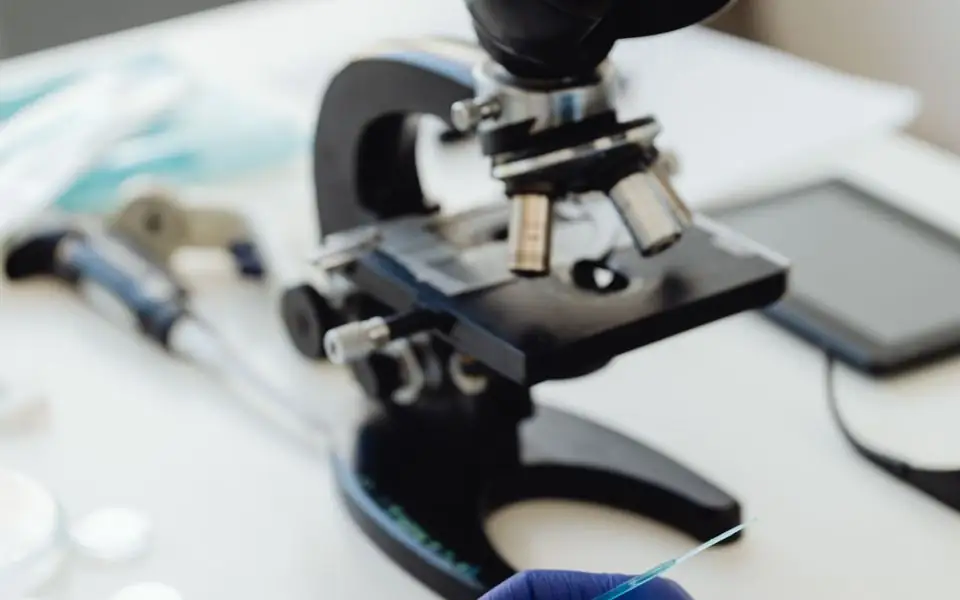
The researchers combine atomic-force microscopy with atom-level modelling. The microscope maps surface shape using forces between a fine probe and the sample. Their results link particular support conditions to changes in island morphology—the shape and arrangement of the deposited material. The conclusions also discuss contamination and surface-energy measurement uncertainty. This article does not turn those results into a numerical power or speed improvement for a complete electronic device.
A possible development route is more consistent fabrication of thin electronic materials. Separate islands and a connected layer can provide different paths for electrical charge, an electrical property of matter. But these experiments concern growth before a complete molecular layer covers the support. Uniformity across a production area, electrical performance, lifetime and cost still need separate tests.
The research affiliations are Italy's CNR institutes and the University of Bologna. A present-address note lists Bookmark s.r.l. for one author; an address does not establish patent ownership or an exclusive licence. Sigma-Aldrich is identified as a material supplier in the methods, which also does not make it the inventor. The reviewed evidence does not identify a company exclusively commercialising this study or establish the current holder of any relevant registered patent.
Potential business activities include substrate materials, deposition equipment, surface measurement and process design. Deposition means building up material on a surface, for example from vapour. The paper does not establish which company wins commercial orders. A company should not be labelled a beneficiary merely because it works in semiconductors. The copyright licence allowing discussion of the paper is also separate from any technology rights needed for manufacture.
No directly linked listed security, technology-specific revenue or current share price was verified. To connect this research to company growth, improved understanding would have to improve a customer's product or yield, generate repeat orders and leave a profit after additional equipment and inspection costs. Yield is the share of manufactured items that work properly. Revenue is sales; profit is what remains after costs. The current evidence does not support a stock-return forecast or a fair-value estimate.
A better outcome would reproduce the surface-control effect in independent experiments and working devices. A limited outcome would remain a tool for explaining growth. An adverse outcome would have contamination, measurement errors or production variation obscure the benefit. The next evidence is more precise surface measurement, actual device performance and technology-transfer agreements. Glossary: morphology is shape and arrangement; reproducibility means obtaining the result again under comparable conditions; commercialisation means reaching products that customers can actually buy and use.
Our reading
Electronic materials depend on what is deposited and on where and how it grows. Separating an explanation of the underlying mechanism from established company earnings is essential to reading this result accurately.
Research and sources
Research published: 2026-11-12 · Physical Review Materials · DOI: 10.1103/h6jw-r5st
Original reporting, explanations and conditional analysis by Coo Trend Ledger. Research: Cristiano Albonetti, Emilio Lorini, Franco Dinelli, Stefano Donati and Luca Muccioli, Morphological transitions in organic submonolayer films due to variations in the surface energy of native silicon oxide substrates, Physical Review Materials 10, 113401, published November 12, 2026; DOI 10.1103/h6jw-r5st. Source: American Physical Society. CC BY 4.0: https://creativecommons.org/licenses/by/4.0/. Independently paraphrased with original analogies and analysis; no figures or quotations reproduced. Company-role statements are limited to affiliations and supplier information actually disclosed by the paper; no exclusive commercial rights or stock recommendation are asserted.
 Science
 Science