Source-checked research explainer
A clock that replaces lost ions and keeps running
조회수 확인 중 · Loading views
Country / region: United States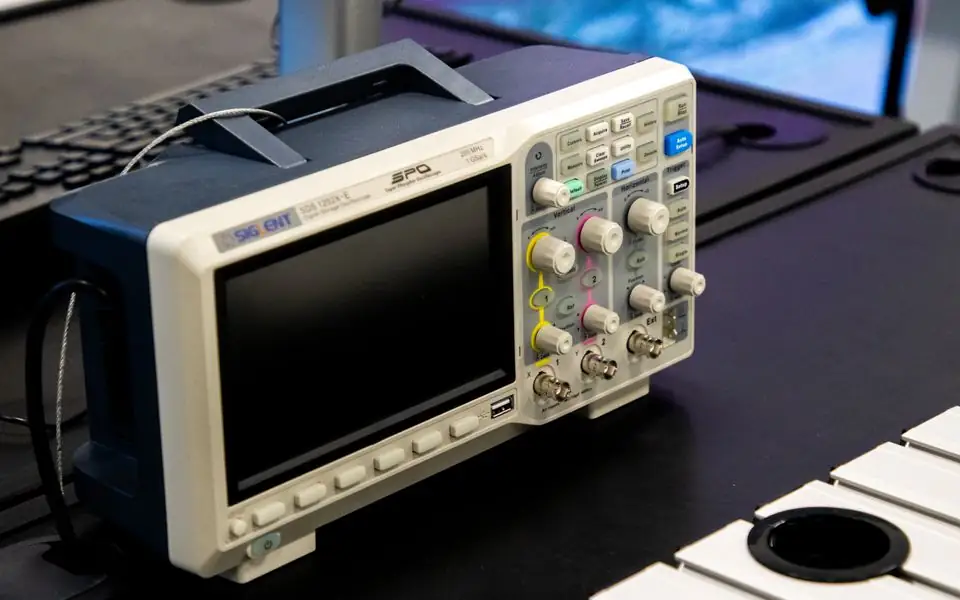
The experiment routes control light through a chip and automatically replaces missing ions to keep an optical atomic clock operating.
An accurate clock is hard to deploy if someone must repair it whenever a component disappears. Atomic clocks use a repeatable atomic response as a timing reference. Optical atomic clocks use the rapid oscillations of light. An oscillation is a repeating change, not a tiny hand rotating inside an atom. The system repeatedly checks whether light’s frequency, its repetition rate, matches the reference response.
This research uses electric forces to confine ions: electrically charged atoms. An atom can change between particular energy states rather than taking any arbitrary energy value. Reading its response to light matching that energy difference allows the light frequency to be steered toward the reference. With several ions, one can disappear while others still supply information. But the system must also identify which remain and refill empty positions.
The team delivers clock-control light through on-chip waveguides, small paths guiding light. This replaces part of the task of aligning many free-space optical components with manufactured paths. It does not put every laser, vacuum component and electronic controller onto a single chip. A laser produces light with selected properties; a vacuum contains very little gas.
The experiment used up to four ytterbium ions. Ytterbium is a chemical element. Automatic replacement and transport supported repeated continuous clock runs lasting more than two hours despite ion loss. The central advance is integration of operations, rather than a world accuracy record. Continuous runtime, accuracy and long-term reliability are different measures.
Room-temperature apparatus does not mean eliminating laser cooling of the ions’ motion. Cryogenic means extremely cold; the surrounding apparatus was not cooled to such temperatures. The paper identifies vacuum, light-coupling losses and ion heating as improvement areas. Heating here means increased motional energy. Replacing lost ions is distinct from eliminating the causes of their loss.
A possible application is maintaining a timing reference where continuous manual adjustment is difficult. Communications equipment needs synchronisation to exchange signals correctly. This experiment does not establish satellite-free navigation or certified outdoor operation. Navigation means determining position and direction of travel. Vibration, temperature changes, long-duration use and comparison with other clocks require validation.
The manufacturing chain must change too. Repeatable waveguides, precise attachment of optical fibres, vacuum-compatible materials and light and voltage controllers must work together. An optical fibre is a thin strand carrying light. Yield means the fraction of manufactured units passing requirements. A few successful chips do not establish low assembly, rejection or maintenance costs.
The research originates with Sandia and UCLA authors. The paper identifies Sandia as the trap’s designer and fabricator and discloses public support. Daniel Stick’s present address is IonQ; Hayden McGuinness’s is Quantinuum. A present-address note does not establish research sponsorship, patent ownership or an exclusive licence. Copyright in the paper and patents on a device are separate rights. Relevant patent numbers, current owners and licences were not verified for this article.
IonQ is a commercial comparison because it has a specific clock contract. Its November 5 announcement describes a contract through a US Defense Advanced Research Projects Agency programme to deliver 25 optical atomic clocks. We did not establish that those products use this Sandia chip or control method. IonQ is therefore a participant in the same application market, not an identified owner of this research. Quantinuum is mentioned only as an author’s present address; its listing status and ownership route were not inferred.
IonQ is listed on the New York Stock Exchange as IONQ, checked against its official announcement on November 15, 2026. Third-quarter 2026 company revenue was US$173.8 million; IonQ Platform revenue was US$90.3 million. Dividing the latter by the former gives about 52.0%, roughly 52 out of 100. The segment contains multiple products, so that is neither a clock revenue share nor revenue attributable to this paper.
Sales, profit and cash are different. The company’s quarterly securities filing reports a third-quarter IonQ Platform operating loss of US$105.6 million. Operating loss means operating costs exceeded operating revenue. Its January–September operating cash outflow was about US$570.3 million, a different period and measure from the three-month segment loss. Cash outflow is actual net cash leaving operations, not an accounting loss.
The company says it completed a US$2.0 billion equity offering on October 16. Selling new shares can finance research and production while reducing the ownership percentage represented by an existing share: dilution. More financing does not eliminate technical, customer or manufacturing risks. Cash outflow does not by itself mean immediate exhaustion either. Acquisitions, future spending and available funds must be considered; we do not infer a runway by simple division.
For stock value, technical success must connect to product adoption, revenue and profit after costs. If investors already price in substantial growth, a good scientific result does not guarantee a higher share price. No current quotation, timestamp or valuation multiple was verified. A multiple compares a company’s market price with a measure such as earnings. A contract announcement, accounting recognition of revenue and receipt of customer cash are also distinct events.
The optimistic case requires independent and customer-environment reproduction of automatic replacement and stable operation, with lower production and maintenance costs. The baseline is a useful laboratory integration with different trade-offs from existing high-performance clocks. The pessimistic case is persistent cost and maintenance from vacuum, light coupling or chip yield. Watch external reproduction, field and long-duration tests, official patent and licence records, and technical descriptions of actual customer products. No price target or trading signal is assigned.
Terms to revisit: an ion is a charged atom; frequency is repetition rate; a waveguide guides light; a laser produces light with selected properties; a vacuum contains very little gas. An optical fibre carries light; yield is the passing fraction of products; operating loss is a deficit after operating costs; operating cash outflow is net cash leaving operations. Dilution reduces existing ownership percentages when new shares are issued. A contract is an agreement; revenue recognition records sales when the relevant accounting conditions are met.
Our reading
Replacing lost ions addresses a practical systems problem. Author present-address notes and a company’s separate clock contract are verifiable connections, but neither establishes exclusive rights to this research or attributable revenue.
Research and sources
Research published: 2026-11-13 · Physical Review Applied · DOI: 10.1103/6tt6-vpf2
Independent explanation and conditional analysis by Coo Trend Ledger. Research: Tharon D. Morrison, Joonhyuk Kwon, Matthew A. Delaney, Michael Gehl, David R. Leibrandt, Daniel Stick and Hayden J. McGuinness, Autonomous multi-ion optical clock with on-chip integrated photonic light delivery, Physical Review Applied 26, 054043, November 13, 2026, DOI 10.1103/6tt6-vpf2. Research text licensed CC BY 4.0: https://creativecommons.org/licenses/by/4.0/. This article uses original paraphrase and analysis; no figures or quotations reproduced. Corporate reporting: IonQ’s November 5, 2026 results announcement and September 30 quarterly securities filing. Company-address and application-market connections are not patent ownership or investment advice.
- https://journals.aps.org/prapplied/abstract/10.1103/6tt6-vpf2
- https://journals.aps.org/prapplied/pdf/10.1103/6tt6-vpf2
- https://investors.ionq.com/news/news-details/2026/IonQ-Announces-Record-3Q26-Revenues-and-Raises-FY2026-Guidance-to-505---515-Million-as-Backlog-Grows-to-1-2-Billion/default.aspx
- https://www.sec.gov/Archives/edgar/data/1824920/000119312526449829/ionq-20260930.htm
 Science
 Science