Source-checked research explainer
Solar umbrellas for apples: can shade help without costing the harvest?
조회수 확인 중 · Loading views
Country / region: United States
A new Nature Portfolio study models how solar panels could reduce apple sunburn and produce electricity. Its strongest result concerns simulated heat-risk days, while crop yield and investment returns still need separate proof.
An apple can become too hot even when the surrounding air feels less extreme. Growers already use shade and evaporative cooling, which removes heat as water becomes vapour. Agrivoltaics puts electricity-producing solar panels above or among crops. The appeal is sharing land, but an orchard needs enough light, air and room for farm machinery as well as electricity.
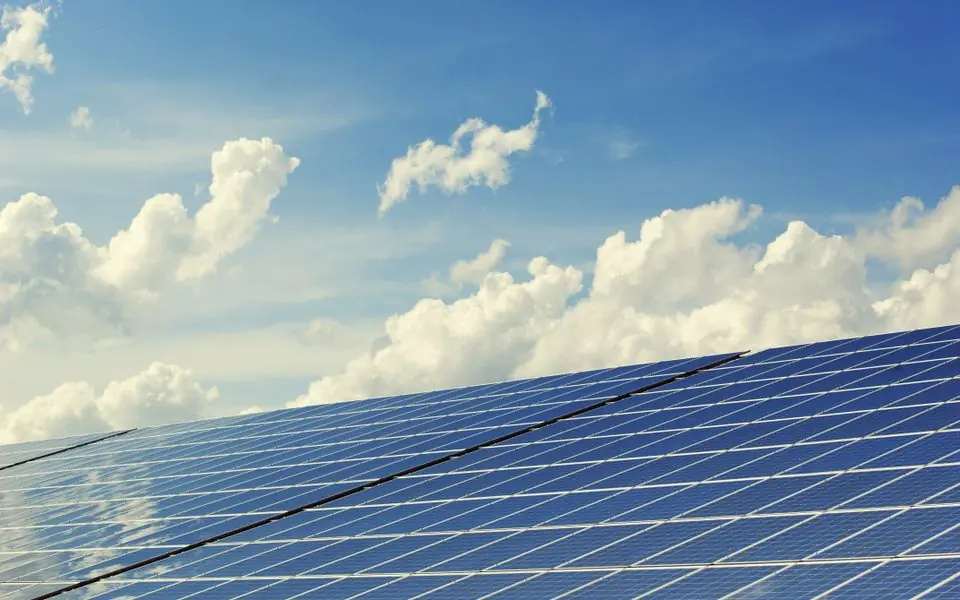
Photovoltaic panels convert part of incoming sunlight into electricity. Electricity involves moving electric charge; electrons, tiny negatively charged constituents of atoms, carry charge in many materials. The panels also intercept light that would otherwise reach fruit. Think of an umbrella that generates electricity, with an important difference: panels can change wind flow and the distribution of light across an entire orchard.
Fruit temperature follows an energy balance: incoming and outgoing heat must be counted together. Sunlight adds energy, and moving air can carry heat away by convection. Shade lowers incoming heating, but slower wind can reduce cooling. Plants also need light for photosynthesis, the process of using light to make sugars. More shade therefore does not automatically mean a better harvest.
The paper compares six designs: single-axis tracking panels that rotate around one axis, and fixed east–west dual-tilt panels, each at three panel densities. It models 49 Washington-state locations and uses 2013–2022 weather comparisons. These are simulated locations, not 49 orchards where these structures were experimentally installed. The risk threshold is 43°C at the surface of Honeycrisp apples, not air temperature or a universal limit for every apple variety.
PVsyst software estimated light and electricity. Small flat tracking surfaces represented curved fruit, and a fruit energy-balance model estimated surface temperature. Wind reductions of 10–35% were tested as assumptions. Under the study’s modeled comparisons, high-density layouts reduced sunburn-risk days by 90–99%. That does not mean 90–99% more apples, or a measured improvement in fruit quality.
The competing effect matters: with a 30% wind reduction, some low-density tracking cases had more modeled risk than an unshaded control. Dense panels also remove light needed for growth and sugar formation. The study therefore does not establish the density that maximizes saleable fruit or combined farm profit. Actual weather, canopy shape, fruit position and variety could change the outcome.
The Results report a median levelized cost of electricity of USD 78 per megawatt-hour for high-density tracking. This spreads modeled lifetime costs over electricity generation; one megawatt-hour is 1,000 kilowatt-hours. The calculation assumes a 4% interest rate and specified equipment and structural costs. It is not an electricity sale price, retail tariff, farmer profit or a guarantee for another country. Fruit revenue requires a separate calculation.
Reproduction also has limits. The Results describe a fruit proxy three feet above ground, while the Methods describe a four-foot control fruiting zone. This reporting has not reconciled that difference or rerun the model. The fruit proxy and heat-transfer assumptions simplify reality, and some historical Washington AgWeatherNet weather is proprietary. The authors report reviewed, spot-checked ChatGPT-assisted coding, not AI-generated observations or conclusions. None of these statements substitutes for independent validation.
Before commercial adoption, field trials should compare several seasons of fruit temperature, marketable yield, sweetness, irrigation, wind and electricity. Structures must permit machinery and withstand local conditions; grid connection, maintenance, insurance and financing also cost money. A layout that saves fruit from heat could still lose value by reducing growth or by costing too much to build.
Grace C. Wu and Riley Tinianov are co-first authors, with collaborators at the University of California, Santa Barbara, Washington State University and other organizations. Funding includes Washington climate funding and US Department of Agriculture support. Published on 24 November 2026 in npj Sustainable Agriculture, this is a Nature Portfolio journal article, distinct from Nature itself. No competing interests are declared. This reporting has not verified a current patent, exclusive licence or company ownership of the specific design; affiliations and funding do not establish those rights.
PVsyst SA’s official terms identify its software intellectual property and subscription model. Its software was a research tool, not proof of a new software order or ownership of the orchard design. A stock-exchange listing or ticker for PVsyst SA has not been independently verified here. Nextpower is a separate, indirect sector candidate: its official agrivoltaics page markets NXHorizon trackers, NXNavigator software and design services. It is not established as this paper’s partner or rights holder, and those products are not thereby validated for Honeycrisp orchards.
Nextpower’s official FAQ identifies Nasdaq ticker NXT, checked on 25 November 2026. Its 28 October release for the quarter ended 2 October reports company-wide revenue of USD 1,109 million, net income of about USD 165 million under US GAAP accounting rules, a 14.9% net margin and operating cash flow of USD 158 million. The quarter includes approximately USD 99 million of manufacturing-tax-credit vendor rebates and tariffs, net. These figures are not orchard or agrivoltaics revenue. No current share price, valuation multiple or separately verified agrivoltaics profit is supplied here.
In an optimistic scenario, orchard trials preserve saleable yield and customers sign profitable equipment or software contracts. In a middle scenario, adoption stays limited to suitable sites. In a pessimistic scenario, lost crop value, wind effects, structural cost or competition defeats the project. Next evidence should be field results, actual orders and segment disclosures. Technology success must still become customer adoption, revenue and profit before it can support share value; market expectations may already include growth.
Our reading
The useful comparison has two balances: heat entering and leaving fruit, and money entering and leaving a farm project. Fewer modeled risk days alone settles neither harvest value nor investment value. New-share financing could dilute existing shareholders if a developer needs it; this is a conditional risk, not a claim that Nextpower currently needs funding. These scenarios are editorial interpretation, without invented probabilities, price targets or trading instructions.
Research and sources
Research published: 2026-11-24 · npj Sustainable Agriculture · DOI: 10.1038/s44264-026-00205-1
Independent explanation of Wu, Tinianov and colleagues, “Agrivoltaic shading impacts on apple sunburn risk”, npj Sustainable Agriculture 4, 95 (24 November 2026), DOI 10.1038/s44264-026-00205-1, and the official company sources below. The paper is CC BY 4.0: selected findings are explained and translated here, with limitations and editorial analysis added. No original figures, proprietary weather, software or source code are reproduced. No author or company endorsement is implied.
- https://www.nature.com/articles/s44264-026-00205-1
- https://creativecommons.org/licenses/by/4.0/
- https://nextpower.com/agrivoltaics
- https://investors.nextpower.com/news/news-details/2026/Nextpower-Reports-Q2-Fiscal-Year-2027-Financial-Results/default.aspx
- https://investors.nextpower.com/resources/investor-faqs/default.aspx
- https://www.pvsyst.com/en/
- https://www.pvsyst.com/pdf/common/subscription-contract-english.pdf
- https://www.pvsyst.com/pdf/common/general-conditions-of-use-english.pdf
 Science
 Science