Source-checked research explainer
How can desert dust help high clouds persist?
조회수 확인 중 · Loading views
Country / region: Germany · Austria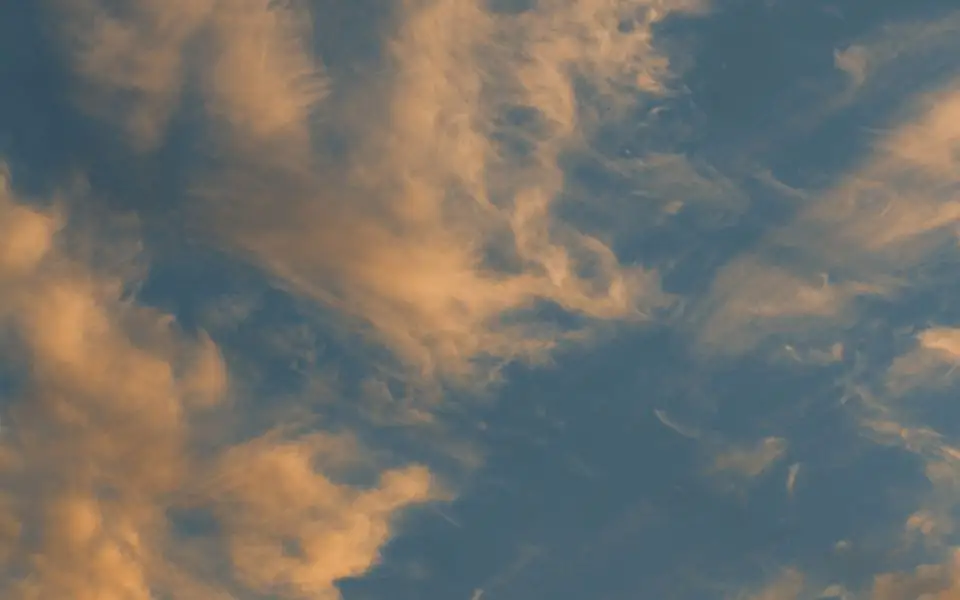
Dust can provide surfaces for ice formation high in the atmosphere. A new modeling study constrained by European observations from 2014 examines how ice formation, cloud-top cooling, and air circulation together sustain dusty cirrus.
A small support can help a stack of blocks keep its shape. Desert dust can similarly provide a starting surface for ice high in the atmosphere. But clouds are not rigid stacks: water changes state, air moves, and light and heat are continually exchanged. This study linked those processes to investigate why high, dust-rich ice clouds can persist.
Kasper Juurikkala, Tomi Raatikainen, Martina Krämer, Christina J. Williamson, and Ari Laaksonen published this final revised, peer-reviewed study in Atmospheric Chemistry and Physics on November 16, 2026. Institutions include the Finnish Meteorological Institute, Johannes Gutenberg University Mainz, and the University of Eastern Finland. This new paper analyzes a dusty European cloud case from 2014, not newly observed clouds in 2026. This article reviewed the public text without rerunning data or calculation code.
Cirrus are high clouds composed mainly of small ice crystals. This paper concerns a particular thick, dust-rich cirrus with vertical air circulation. Mineral dust consists of small particles from rocks and soil. Water vapor is invisible gaseous water; ice crystals are solids with water molecules arranged regularly. Molecules are units of connected atoms, the basic units of matter. Under very cold conditions, dust surfaces can help ice begin forming.
The initial formation of ice is called ice nucleation. When it uses another material’s surface, such as dust, it is heterogeneous nucleation; “heterogeneous” does not refer to different biological species. The central calculation concerns water vapor forming ice on dust and subsequent ice growth. Converting vapor to ice releases latent heat—energy exchanged during a change of state. Energy is the capacity to cause change or do work. These heat exchanges can also affect surrounding air movement.
The researchers used a cloud case involving Saharan dust transported over Europe in April 2014. Direct measurements by the HALO research aircraft on April 4 were combined with ground-based cloud radar and satellite observations to constrain the model. Radar sends radio waves and examines returning signals. Aircraft, ground, and satellite data sample different times and places and do not coincide perfectly. A sample is the data actually examined, so differences among observations must be considered.
The cloud was simulated with UCLALES-SALSA, a large-eddy simulation model. Large air eddies are calculated explicitly on the grid, while smaller motions are approximated. A grid divides the calculation space into cells; approximation simplifies reality. The main case covered 24 kilometers by 24 kilometers, with 150-meter horizontal grid spacing. A kilometer is 1,000 meters. This did not reproduce every cloud across Europe, nor was it an experiment adding dust to the actual sky.
With sufficient dust, simulations maintained feedback in which small ice crystals kept forming and supported the cloud. Under this case’s conditions, persistent convective structure could be maintained when the initial layer-mean dust number concentration was about one particle per cubic centimeter or higher. A cubic centimeter is a volume one centimeter on each side; number concentration counts particles within that volume of air. Convection transfers heat and matter through vertical air movement. This model result depends on dust size distribution, temperature, and humidity; it is neither a universal cloud threshold nor a ground-level health standard.
The chain continues beyond ice formation. Loss of energy through longwave radiation at cloud top can cool the air and sustain circulation. Longwave radiation consists of longer-wavelength electromagnetic waves associated with heat; wavelength is the repeat distance of a wave. Daytime shortwave solar heating can weaken this cooling. With less dust and weaker ice formation, cloud-top cooling and circulation could weaken and the structure collapse. Feedback means a change affects its originating process through other changes. Cloud-top cooling does not mean an equivalent cooling of the entire Earth.
A major uncertainty is that changing the ice-formation parameterization substantially changed results. Some features and layers agreed well with observations, while ice numbers in the lower layer of falling ice differed considerably. Ice shape, fall speed, large-scale rising or sinking air, and subgrid eddies also contribute uncertainty. The study used one initial temperature profile for ice formation, leaving applicability across other temperatures unresolved. It must not be generalized into a claim that dust always thickens or prolongs every cloud.
The mechanism may help improve weather and climate models that combine dust, ice, radiation, and air motion. Thick high clouds can affect sunlight reaching the surface, creating possible links to solar-generation forecasting. But this paper did not demonstrate increased power-station output or lower forecasting costs. Next steps include replication with other dust cases and temperatures, better-coordinated aircraft, ground, and satellite measurements, and operational forecast validation of improved parameterizations.
The research originates with the named institutional researchers, not a verified company product. Support includes the Emil Aaltonen Foundation, the Research Council of Finland, and EU Horizon Europe. The disclosure states that at least one author is a journal editorial-board member, an independent editor handled review, and no other competing interests were declared. GRIMM particle instruments and METEK cloud radar mentioned in the methods are observation equipment. Their names do not establish ownership of the cloud mechanism; patent owners and exclusive licensees were not verified.
Links to companies and shares remain indirect, in instruments, weather-analysis software, and solar forecasting services. Growth would require demonstrating that improved physics produces better real forecasts, followed by customer adoption, revenue, and profit after costs. The paper did not verify any company’s contracts, listed legal entity, traded security, or business results. No originating company, share-price rise, or target price is assigned without evidence.
Our reading
The supported finding is that, in a model constrained by a specific observed case, coupling dust-based ice formation with radiation and convection can explain cirrus persistence. The optimistic scenario is replication across conditions followed by independent demonstrations in weather and power forecasting. The baseline is research reducing errors in ice parameterizations; the pessimistic scenario is narrower applicability because of temperature, dust properties, and observation differences. Next evidence includes other cases and forecast validation. These results alone cannot calculate company profit or investment returns.
Research and sources
Research published: 2026-11-16 · Atmospheric Chemistry and Physics · DOI: 10.5194/acp-26-16173-2026
Source: Kasper Juurikkala, Tomi Raatikainen, Martina Krämer, Christina J. Williamson, Ari Laaksonen. “Mineral dust concentration controlling convective cirrus structure and persistence: a large-eddy simulation study with observational constraints.” Atmospheric Chemistry and Physics 26, 16173–16202, 16 November 2026. DOI: 10.5194/acp-26-16173-2026. Original: https://acp.copernicus.org/articles/26/16173/2026/. Creative Commons Attribution 4.0 (CC BY 4.0): https://creativecommons.org/licenses/by/4.0/. Final revised peer-reviewed article. This adaptation translates and paraphrases the research and adds accessible explanations and conditional analysis. Original figures and tables are not reproduced; data and calculation code were not independently rerun.
 Science
 Science